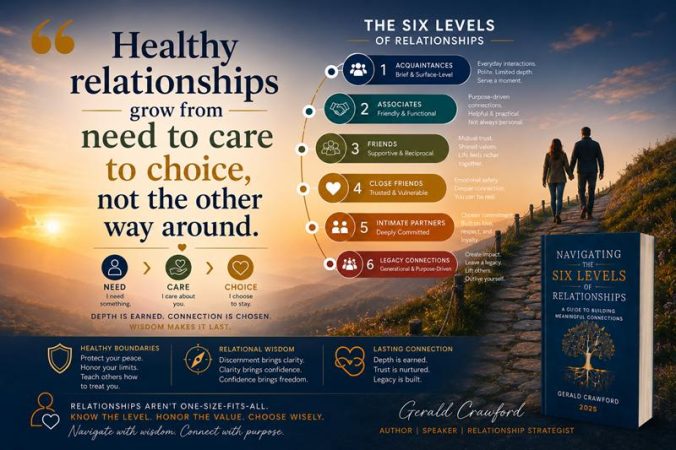
Healthy Relationships Grow from Need to Care to Choice, Not the Other Way Around
Human relationships often begin with need. As children, we need caregivers for safety and survival. As adults, we need companionship, support, encouragement, understanding, and connection. Need, in itself, is not weakness — it is part of human nature. Yet healthy relationships do not remain trapped at the level of need.
As relationships mature, something deeper happens.
Need begins to evolve into care.
Care matures into intentional choice.
And choice becomes the foundation of lasting, healthy connection.
This progression is important because relationships built only on need can become dependent, fragile, or transactional. But relationships that grow into mutual care and eventually become sustained by conscious choice often develop depth, respect, and emotional stability.
In Navigating the Six Levels of Relationships by Gerald Crawford, Crawford describes human relationships through six categories: those we love and care for, those we need, those we use, those we tolerate, those we stand indifferent to, and those we simply do not care about. His framework highlights that relationships exist at different levels of emotional purpose and significance, but the healthiest and deepest connections often move beyond basic need into care, mutual respect, and chosen commitment.
This insight resonates with the work of several respected thinkers in psychology and relationship science.
Human Connection Begins with Need
Psychiatrist and attachment theorist John Bowlby, founder of attachment theory, argued that human beings are biologically wired to seek attachment and emotional connection. From infancy onward, need is the beginning of bonding.
We need:
- safety,
- comfort,
- reassurance,
- connection,
- and emotional responsiveness.
Bowlby’s work reminds us that need is not something to be ashamed of. It is the natural starting point of human attachment.
Crawford’s category of “those we need” reflects this reality. Some relationships enter our lives because they provide support, guidance, companionship, protection, or emotional stability during important seasons.
But healthy relationships do not stay at need alone.
If they do, they risk becoming imbalanced or emotionally dependent.
Need Must Mature into Care
Psychologist and humanistic thinker Erich Fromm, in The Art of Loving, argued that mature love is not merely a response to need but an active expression of care, responsibility, respect, and knowledge.
Fromm famously challenged the idea that love is simply “being loved” or “getting needs met.” Instead, he taught that love becomes mature when people move from dependency toward genuine care for another person’s wellbeing.
This aligns closely with Crawford’s relational framework.
A relationship based only on what one person needs may remain transactional or fragile. But when care develops, people begin to move beyond self-interest.
They begin to ask:
- How do I support you?
- What matters to you?
- How do we nurture this relationship together?
That is the movement from need to care.
Mature Relationships Are Sustained by Choice
Psychologist and relationship researcher John Gottman spent decades studying long-term relationships and found that healthy relationships are sustained not merely by emotion or attraction, but by intentional behaviors — choosing trust, choosing responsiveness, choosing kindness, and choosing commitment over time.
This is where relationships reach maturity.
Choice means:
- staying present when it matters,
- investing in understanding,
- practicing respect,
- protecting trust,
- and intentionally nurturing connection.
Crawford’s category of “those we love and care for” often reflects relationships that have moved beyond need and become sustained by mutual choice.
These are relationships where people are not merely together because they need something — they are together because they choose one another repeatedly.
That is a powerful difference.
Why Reversing the Order Creates Problems
Many unhealthy relationships begin by demanding choice before care has developed, or by forcing care where only need exists.
For example:
- people confuse emotional dependence with love,
- they demand commitment before trust is built,
- they expect loyalty where mutual care has not yet formed,
- or they remain together out of need alone rather than genuine choice.
This creates imbalance.
Crawford’s six-level relationship model helps clarify that relationships evolve in stages and occupy different emotional functions. Some remain practical or situational. Others deepen through care and intentional emotional investment.
Healthy relationships cannot skip the process.
Need may begin the bond.
Care deepens it.
Choice strengthens it.
Love Is Strongest When It Is Chosen
“Healthy relationships grow from need to care to choice, not the other way around.”
This statement reflects an important truth about relational maturity.
Need creates connection.
Care creates emotional depth.
Choice creates lasting commitment.
In Navigating the Six Levels of Relationships by Gerald Crawford, relationships are understood as existing on different levels of emotional significance, but the healthiest relationships are those that mature beyond survival, utility, or dependency.
They become grounded in:
- mutual care,
- emotional respect,
- intentional investment,
- and repeated choice.
Because healthy love is not simply about needing someone.
It is about growing into a relationship where care becomes genuine, and connection becomes a conscious, mutual choice made freely over time.


Leave a Reply