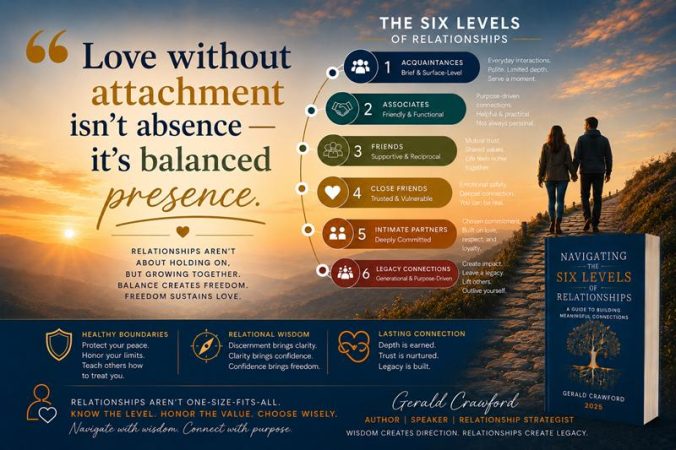
Love Without Attachment Isn’t Absence – It’s Balanced Presence
Love is often misunderstood as emotional attachment so intense that two people become inseparable, dependent, or consumed by one another. Many assume that to love deeply means to cling tightly, to need constantly, or to fear distance as a sign of emotional loss. Yet some of the healthiest forms of love are not built on possession, insecurity, or emotional overdependence.
They are built on presence.
Balanced, secure, intentional presence.
“Love without attachment isn’t absence — it’s balanced presence” captures a profound truth about mature relationships: it is possible to love deeply without losing balance, to care fully without becoming consumed, and to remain emotionally connected without turning love into fear-based dependence.
In Navigating the Six Levels of Relationships by Gerald Crawford, Crawford explores relationships through six categories: those we love and care for, those we need, those we use, those we tolerate, those we stand indifferent to, and those we simply do not care about. His framework reminds us that relationships carry different emotional purposes, and that the deepest relationships are healthiest when they move beyond dependency into mutual care, respect, and emotional balance.
This perspective aligns with the work of several influential thinkers who have written about love, attachment, and emotional maturity.
Love Is Not Possession
Psychologist and philosopher Erich Fromm, in The Art of Loving, argued that mature love is not about possession or emotional dependency, but about care, responsibility, respect, and knowledge.
Fromm challenged the idea that love means “I need you because I love you.”
Instead, he proposed a healthier truth:
“I love you because I choose to care for your wellbeing.”
This distinction is powerful.
Possessive attachment often seeks control or reassurance.
Mature love seeks connection without ownership.
Crawford’s relational framework reflects this wisdom by helping people distinguish between relationships of need and relationships of genuine care. Deep love is healthiest when it grows beyond emotional dependence into mutual presence and intentional care.
Secure Attachment Is Balanced Connection
Attachment theorist and relationship therapist Sue Johnson emphasizes that secure attachment is not clinginess — it is emotional connection grounded in trust, responsiveness, and safety.
Securely attached people do not fear every moment of distance.
They do not confuse independence with abandonment.
They do not demand constant reassurance to feel loved.
Instead, they experience what balanced presence looks like:
- emotional availability,
- mutual trust,
- respect for individuality,
- connection without control,
- and closeness without emotional collapse.
This aligns beautifully with Crawford’s category of “those we love and care for.”
Healthy love does not erase identity.
It strengthens connection while allowing both people to remain whole.
Presence Without Emotional Overdependence
Buddhist teacher and author Thich Nhat Hanh often spoke about loving presence as the ability to be fully available to another person without attachment rooted in fear or possession.
For Thich Nhat Hanh, love was not about clinging.
It was about presence, understanding, compassion, and freedom.
This is a deeply mature view of love.
Love without unhealthy attachment does not mean emotional distance.
It does not mean indifference.
It does not mean withholding care.
It means:
- loving without controlling,
- caring without consuming,
- supporting without suffocating,
- and remaining present without losing balance.
Crawford’s six-level relationship model helps clarify this emotional reality by recognizing that not all love-based relationships are healthiest when driven by need. The strongest relationships often involve love that is secure enough to allow freedom alongside connection.
Why People Confuse Attachment with Love
Many people equate intensity with love.
They believe:
- “If I miss you constantly, it must be love.”
- “If I need you to feel okay, it must be love.”
- “If I fear losing you every moment, it must be love.”
But often, this is not love.
It is insecurity wrapped in attachment.
Healthy love feels different.
It says:
- “I care deeply for you, but I do not own you.”
- “I am connected to you, but I do not disappear in you.”
- “I value your presence, but I do not fear every moment of distance.”
Crawford’s relational framework helps distinguish between need, care, and mature emotional connection.
Love becomes healthiest when attachment is secure rather than fear-driven.
Balanced Presence Is a Sign of Mature Love
“Love without attachment isn’t absence — it’s balanced presence.”
This statement reflects one of the deepest truths about emotional maturity.
Love does not need to cling to be real.
Connection does not need to control to be secure.
Presence does not need possession to be meaningful.
In Navigating the Six Levels of Relationships by Gerald Crawford, relationships are understood as existing on different emotional levels, but the healthiest love-based relationships are those grounded not merely in need, but in balanced care and secure connection.
That kind of love offers:
- trust,
- respect,
- freedom,
- emotional safety,
- and intentional presence.
Because mature love is not the absence of attachment.
It is attachment transformed into balance — a love that stays present without becoming possessive, connected without becoming dependent, and deeply caring without losing emotional freedom.
How useful was this post?
Click on a star to rate it!
Average rating 0 / 5. Vote count: 0
No votes so far! Be the first to rate this post.


Leave a Reply