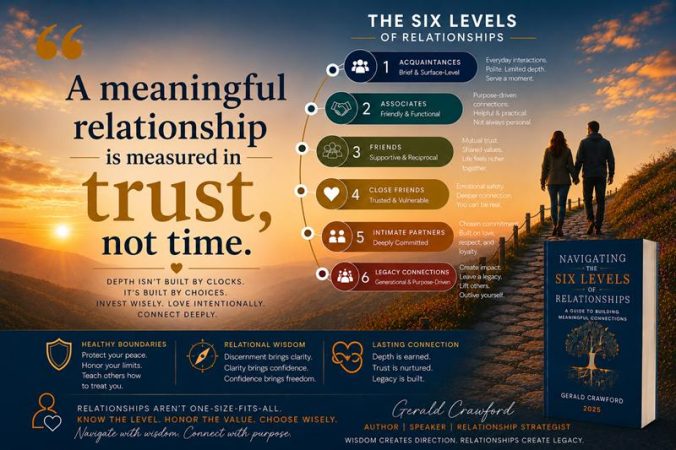
A Meaningful Relationship Is Measured in Trust, Not Time
Many people assume that the value of a relationship is measured by how long it has lasted. Years of friendship, decades of marriage, family history, or time spent together are often seen as proof of relational depth. While time can strengthen connection, time alone does not create meaning.
A relationship can last for years and still lack trust.
Another can form in a short season and become deeply significant because it is built on honesty, reliability, emotional safety, and mutual respect.
This is why meaningful relationships are not measured simply in time — they are measured in trust.
Trust is what transforms familiarity into safety, presence into connection, and time into relational depth.
In Navigating the Six Levels of Relationships by Gerald Crawford, Crawford describes human relationships through six categories: those we love and care for, those we need, those we use, those we tolerate, those we stand indifferent to, and those we simply do not care about. His framework reminds us that relationships do not become significant merely because they exist over time, but because of the emotional quality, trust, and meaning they carry.
This insight aligns closely with the work of several respected thinkers who have written about trust, emotional safety, and relational depth.
Trust Is the Foundation of Emotional Safety
Relationship researcher and psychologist John Gottman spent decades studying healthy relationships and found that trust is one of the central pillars of long-term relational success.
Gottman argues that trust is built in small moments:
- keeping promises,
- responding with care,
- showing consistency,
- protecting emotional safety,
- and demonstrating reliability over time.
Without trust, time means very little.
Two people may share years together and still feel emotionally unsafe, disconnected, or guarded.
Crawford’s category of “those we love and care for” naturally reflects relationships where trust becomes the emotional foundation. These are the relationships where connection deepens not simply because of longevity, but because trust creates security.
Time Creates History; Trust Creates Meaning
Psychologist and humanistic thinker Carl Rogers believed that genuine relationships are built through authenticity, empathy, and unconditional positive regard.
Rogers emphasized that meaningful connection happens when people feel:
- emotionally safe,
- genuinely heard,
- accepted,
- and understood.
These experiences create trust.
Time may create history, but trust creates emotional significance.
This distinction matters because many people stay emotionally invested in relationships simply because of time, even when trust has weakened or never fully developed.
Crawford’s relational model helps clarify this by recognizing that not all long-standing relationships occupy the same emotional category. Some may remain practical, distant, or tolerated despite years of connection.
Trust — not time — determines depth.
Trust Is What Allows Vulnerability
Researcher and author Brené Brown often writes about trust, vulnerability, and belonging. Brown argues that trust is what allows people to become emotionally open without fear of betrayal, rejection, or emotional harm.
Without trust, people protect themselves.
With trust, people begin to belong.
Trust creates space for:
- honesty,
- vulnerability,
- emotional risk,
- deeper intimacy,
- and relational security.
This is why a relatively short relationship built on deep trust can feel more meaningful than a long relationship built on emotional distance or inconsistency.
Crawford’s framework supports this understanding by helping people distinguish between mere relational presence and relationships of true emotional significance.
Why People Confuse Time with Depth
Many people believe:
- “We’ve known each other forever, so it must be meaningful.”
- “We’ve been together a long time, so this must be deep.”
- “We have history, so trust should be assumed.”
But history and trust are not the same.
Time can create:
- familiarity,
- routine,
- shared experiences,
- and memories.
But trust creates:
- safety,
- confidence,
- vulnerability,
- and emotional depth.
Crawford’s six-level relationship model reminds us that relationships exist at different levels regardless of how long they have lasted.
A relationship of need may last years.
A relationship of tolerance may last decades.
A relationship of emotional indifference may continue in form while losing trust entirely.
Time alone does not determine meaning.
Trust Is the Measure of Relational Depth
“A meaningful relationship is measured in trust, not time.”
This statement reflects one of the deepest truths about human connection.
Time can build opportunity.
History can create familiarity.
Shared experiences can build memory.
But trust is what creates meaning.
In Navigating the Six Levels of Relationships by Gerald Crawford, relationships gain emotional significance not because they endure chronologically, but because of the quality of connection they hold.
Trust is what allows people to:
- feel safe,
- be vulnerable,
- invest deeply,
- communicate honestly,
- and remain emotionally present.
Because meaningful relationships are not defined by how long someone has been in your life.
They are defined by whether trust has made that presence truly matter.


Leave a Reply