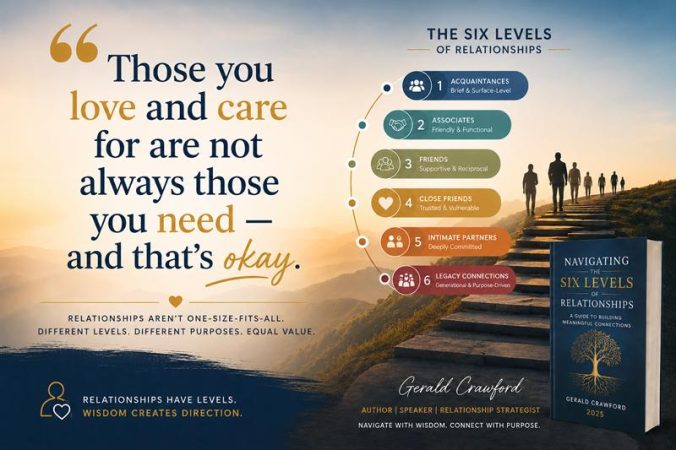
Those You Love and Care for Are Not Always Those You Need – And That’s Okay
One of the hardest emotional truths to accept is that love and need are not always the same thing. We may deeply love certain people, care for them sincerely, and value their presence in our lives — yet still recognize that they cannot provide what we emotionally, mentally, spiritually, or practically need in a particular season of life.
This realization often creates guilt, confusion, or emotional conflict. Many people believe that if they truly love someone, that person should naturally fulfill every emotional need they have. But human relationships are far more complex than that.
In Navigating the Six Levels of Relationships by Gerald Crawford, Crawford explores how relationships exist in different categories: those we love and care for, those we need, those we use, those we tolerate, those we feel indifferent toward, and those we do not care about. One of the book’s most emotionally honest insights is the understanding that the people we love are not always the people we need most in every circumstance. (geraldcrawford.co.za)
This idea resonates strongly with several influential relationship thinkers and psychologists who have explored the distinction between emotional attachment, compatibility, support, and human needs.
Love Does Not Automatically Equal Compatibility
Psychologist and relationship researcher Dr. John Gottman spent decades studying successful and unsuccessful relationships. One of his core findings was that emotional connection alone is not enough to sustain healthy relationships. Long-term relational health depends on emotional responsiveness, communication patterns, trust, and the ability to meet each other’s emotional needs consistently. (gottman.com)
This means it is entirely possible to love someone deeply while still recognizing that the relationship may lack certain qualities necessary for emotional wellbeing, growth, or stability.
Crawford’s framework helps explain this reality. Some people belong in the category of those we love and care for, while others become people we rely on because they provide wisdom, support, security, mentorship, or practical help. Occasionally, these categories overlap. Often, they do not.
Understanding this distinction can prevent people from forcing relationships into roles they were never designed to fulfill.
Attachment Versus Emotional Need
Attachment theorist Dr. Sue Johnson, known for her work in emotionally focused therapy, explains that humans are wired for emotional connection and security. However, people seek different forms of emotional support depending on their personality, attachment style, life experiences, and emotional development. (iceeft.com)
Someone may provide companionship but not emotional safety.
Another may offer loyalty but not understanding.
Someone else may offer wisdom without intimacy.
This does not necessarily diminish the value of the relationship; it simply defines its emotional function more accurately.
Crawford’s relational categories encourage emotional honesty rather than emotional fantasy. Instead of expecting every loved person to satisfy every emotional need, people can begin appreciating relationships for what they genuinely offer.
That honesty creates healthier emotional balance.
The Wisdom of Differentiation
Author and family systems theorist Murray Bowen introduced the concept of “differentiation of self,” which refers to the ability to maintain emotional clarity while staying connected to others. Bowen argued that emotionally mature individuals learn to separate emotional attachment from emotional dependency. (thebowencenter.org)
This idea strongly reflects Crawford’s perspective.
Many people remain emotionally trapped because they confuse love with obligation, or attachment with necessity. They believe that caring about someone means that person must fulfill all relational roles in their lives.
But healthy emotional differentiation recognizes:
- you can love someone without depending entirely on them,
- you can appreciate someone while needing support elsewhere,
- and you can care deeply for people who are not emotionally equipped to meet your deeper needs.
This understanding removes unrealistic pressure from relationships.
Emotional Maturity Means Accepting Relational Reality
One of the greatest signs of emotional maturity is learning to accept people as they are instead of resenting them for what they are not.
Some people are companions.
Some are protectors.
Some are mentors.
Some are seasonal supports.
Some are emotionally close but practically absent.
Others are practically dependable but emotionally distant.
Relationships become healthier when we stop demanding that one person fulfill every role in our emotional world.
Crawford’s six-level model offers a practical and psychologically realistic framework for understanding this complexity. It allows people to stop feeling guilty for seeking support, wisdom, or emotional connection beyond the relationships they already value deeply.
Because sometimes:
- the people we love cannot guide us,
- the people we need may not fully understand us emotionally,
- and the people who help us most may never become emotionally intimate.
That is not betrayal.
That is human reality.
Finding Peace in Relational Honesty
“Those you love and care for are not always those you need — and that’s okay.”
This statement is not cynical.
It is freeing.
It allows people to release unrealistic expectations and embrace healthier emotional boundaries. It encourages gratitude for relationships without forcing them into impossible emotional roles.
Most importantly, it reminds us that human relationships are multifaceted. No single relationship can always meet every emotional, intellectual, practical, or spiritual need throughout life.
Some people walk with us emotionally.
Some strengthen us practically.
Some challenge us intellectually.
Some simply remind us we are not alone.
The wisdom lies not in demanding sameness from every relationship, but in recognizing each relationship for its true value.
And in that recognition, emotional clarity begins.


Recent Comments